
Notre programme NKOLAVOLO II
Regional applications of the same principle of social autonomy.
UNDER DEVELOPMENT
NKOLAVOLO II
Pilot Centre — Municipality of Essé, Centre Region, Cameroon
Location and regional context
Nkolavolo II – Ndoumzock is a rural village situated in the commune of Essé, in the Mefou-et-Afamba department, in the Central Region. The site selected for the pilot centre is located approximately 3 km from the tarmac road. The area is not connected to the electricity grid and mobile phone coverage remains poor, which means that self-sufficient solutions for energy, water and communications must be incorporated from the design stage.
When the project was launched, local educational provision was severely compromised. The neighbouring state school, which serves as the local educational facility for children in the area, had been closed for three years. This situation illustrates the difficulties in accessing sustainable social services in the village and the surrounding areas.
Why Nkolavolo II?
The choice of Nkolavolo II is based on several complementary factors: the needs expressed by the community, the village’s rural location, the availability of sufficient space to develop both social and productive infrastructure simultaneously, and the opportunity to create a project that benefits not only the Centre but also its immediate surroundings.
The Pilot Centre was therefore conceived not as an isolated entity, but as a hub capable of gradually strengthening education, economic activity and the services available in the village and its surroundings.
The social response
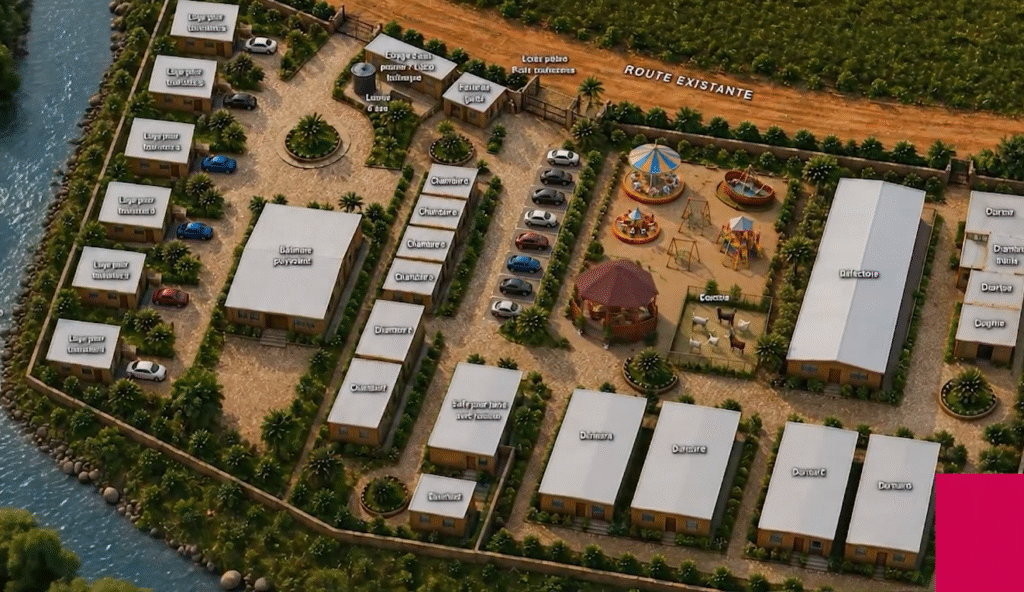
The ISA Pilot Centre’s mission is to take in, protect and support vulnerable children, particularly those who have been abandoned, are orphans or lack a sufficiently protective family environment. Its initial capacity is around 80 children, with a gradual increase in capacity.
The facility comprises the spaces required for daily life and support: accommodation, a kitchen, a dining hall, sanitary facilities, early learning and educational areas, as well as spaces for technological, artistic, cultural and sporting activities. The aim is to provide comprehensive care whilst ensuring close integration with the local community.
Education and community engagement
The Foundation has reoriented its educational project so as not to create a parallel infrastructure where a state school already exists nearby. Priority has therefore been given to the refurbishment and reopening of the neighbouring state school, which had been closed for three years, so that it can accommodate both the children from the Centre and those from the surrounding villages.
This approach enables social investment to be used as a tool that benefits the whole community and strengthens existing public infrastructure rather than bypassing it.
Revenue infrastructure
To gradually contribute to the Centre’s operations, a number of income-generating activities have been planned and will be rolled out in stages:
- Fish farming: the production of fish in dedicated ponds, with a gradual increase in the farm’s capacity.
- Shellfish farming: gradual expansion of this activity is planned at the site, alongside fish farming and other production activities.
- Pig farming: further development of a pig farm tailored to the site’s capacity and identified market opportunities.
- Poultry farming: the gradual introduction of poultry production to complement the Centre’s other activities.
- These activities are not a substitute for the external funding required for construction and equipment. Their aim is to gradually build up the Centre’s own capacity to contribute towards its running costs.
Current phase
Gradual completion of the infrastructure, refurbishment of the state school, preparations for the Centre’s operational launch, and the roll-out of the first income-generating activities.