
Notre programme KOUSSÉRI
Regional applications of the same principle of social autonomy.
TERRITORIAL FRAMEWORK
KOUSSÉRI
Regional Centre Project — Far North Region, Cameroon
Location and regional context
Kousséri est située dans le département du Logone-et-Chari, Région de l’Extrême-Nord, à la frontière avec le Tchad et dans la continuité immédiate de N’Djamena. La ville se trouve sur le corridor Douala/Kribi – N’Djamena, l’un des grands axes de circulation des marchandises entre le Cameroun et le Tchad.
The Far North region also faces significant challenges in terms of resilience, access to essential services, employment and climate adaptation. In this context, local and cross-border economic activities can become a practical means of empowerment when they are better structured and linked to markets.
Why Kousséri?
The choice of Kousséri is linked to its location on the border, its close proximity to the N’Djamena market, the scale of cross-border trade, and the potential of a programme combining production, food security, storage, the organisation of women producers and access to markets.
As in Garoua-Boulaï, the project aims to harness the momentum of the corridor not as an end in itself, but as an opportunity to strengthen the economic capacity of the women and communities living around these trade routes.
The proposed social response: Les Bâtisseuses des Frontières
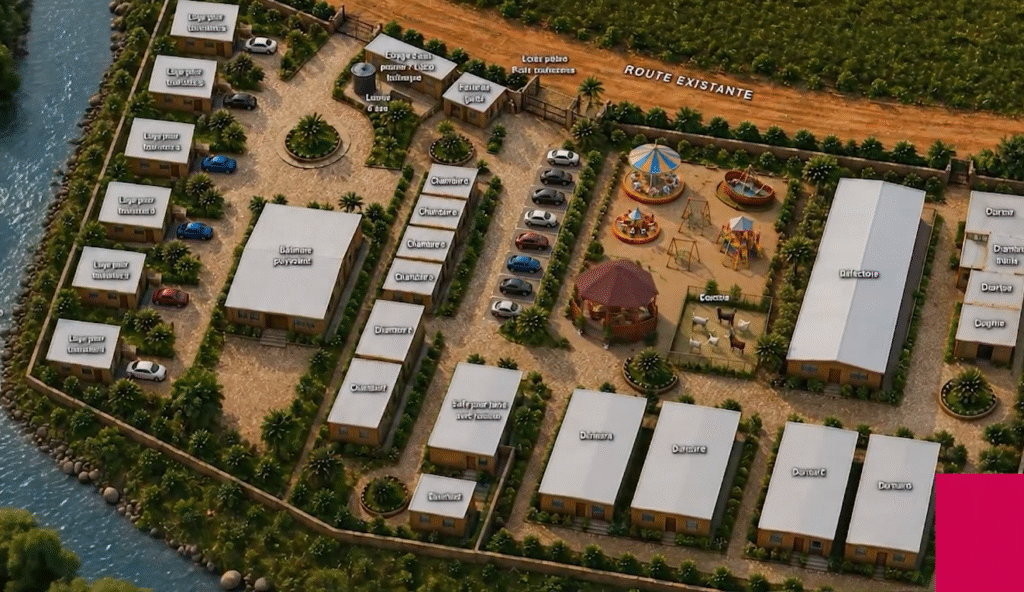
The Kousséri regional centre is intended to serve as a hub for training, support and economic development for women and girls. It will be able to provide technical training, financial education, entrepreneurial support, assistance with setting up groups or cooperatives, collection, quality control, storage and access to markets.
Production must remain based in the villages and production areas. The centre then acts as a platform for services and marketing, so that individual women producers do not have to bear the burden of supply, storage, quality control, transport and marketing on their own.
Revenue infrastructure
The final activities will be decided following an assessment and consultation. The areas under consideration include, in particular, agriculture, livestock farming, the storage and preservation of produce, as well as its processing and marketing where economic conditions warrant it.
The economic model remains that of the Bâtisseuses des Frontières: initial funding provides the tools and support; production generates income for the beneficiaries; marketing then gradually contributes to the organisation’s running costs, working capital and the development of the network.
Developing the project in partnership with the local community
ISA does not wish to set Kousséri’s priorities from a distance. The framework must involve administrative and municipal authorities, social and technical services, women’s organisations, farmers and livestock breeders, traders, transport operators, community organisations and other local stakeholders.
These consultations will help to identify the priority social need, the most viable sectors, the precise role of the future centre and the infrastructure that is genuinely required. Until this stage is complete, the website should present Kousséri as a project within a regional framework.
Current phase
Identifying stakeholders, establishing contact, preparing for consultations and defining the scope of the study for the future regional centre.