
Notre programme GAROUA-BOULAÏ
Regional applications of the same principle of social autonomy.
TERRITORIAL FRAMEWORK
GAROUA-BOULAÏ
Regional Centre Project — Eastern Region, Cameroon
Location and regional context
Garoua-Boulaï is a border town in the Eastern Region, situated on the Cameroon–Central African Republic route and on the Douala–Bangui corridor. Its location makes it a key transit point for people, goods and produce between Cameroon and the Central African Republic.
This economic momentum coexists with social vulnerabilities and a need to better connect local communities – particularly women and girls – to the opportunities created by agriculture, livestock farming, processing, trade and cross-border flows.
Why Garoua-Boulaï?
The area was selected as the focus for the ‘Les Bâtisseuses des Frontières’ programme due to its strategic location on a regional corridor, the scale of trade with the Central African Republic, and the potential to better link local production to established markets.
The aim is not to replicate the Nkolavolo II Centre there. On the contrary, ISA is seeking to develop a model specific to a border area, in which women’s economic empowerment and the development of local value chains form the core of the social response.
The proposed social response: Les Bâtisseuses des Frontières
The programme is primarily aimed at women and girls in border areas. It is designed to help foster the emergence of organised, technically competent women producers who receive support for their activities and are connected to more regular markets.
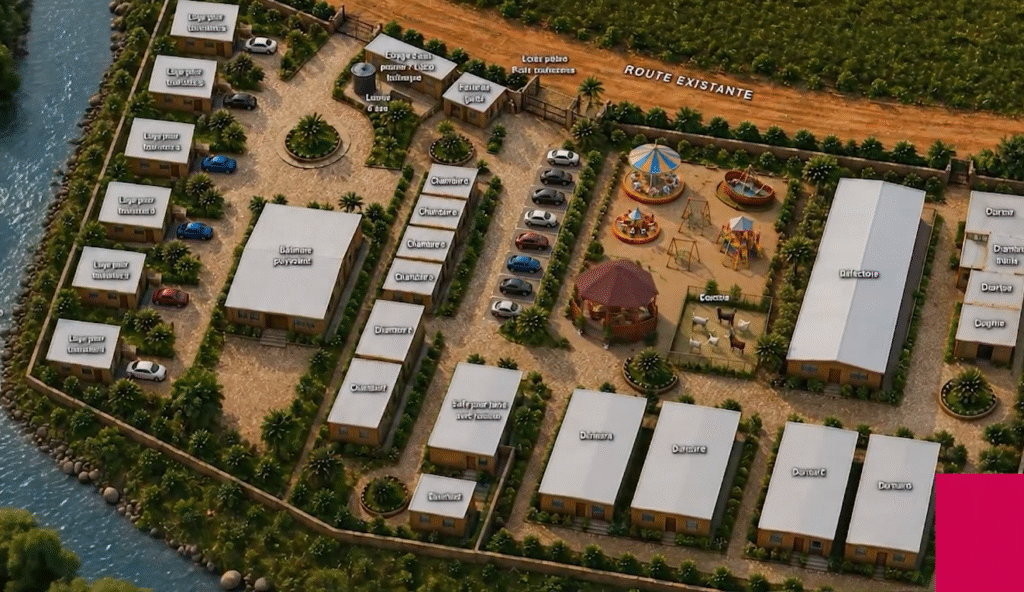
The future regional centre is envisaged as a hub for: training; the provision or organisation of inputs; technical support; quality control; collection; storage; consolidation; and marketing. Production, meanwhile, is intended to remain largely based in the villages and production areas.
Revenue infrastructure
The focus of the work is on agriculture and livestock farming, supplemented where relevant by processing, storage, preservation and marketing. However, the specific sectors have not yet been finalised at this stage: they are to be selected following regional consultations, taking into account available resources, local expertise, technical constraints and actual market opportunities.
The mechanism in question is simple: women producers are paid for their compliant produce; the Foundation organises the collection and marketing of the produce; a portion of the profit margins is then used to fund support services, logistics, inputs, monitoring, working capital and the gradual expansion of the programme.
Developing the project in partnership with the local community
The current phase is deliberately focused on listening. Local authorities, technical services, social organisations, women’s organisations, producers, livestock farmers, traders, transport operators, associations and other stakeholders must be consulted before finalising the centre’s remit.
The specific site, the infrastructure to be built and the priority sectors will therefore be defined once this scoping exercise has been completed. This transparency must remain clearly visible on the website: Garoua-Boulaï is currently a regional project in the planning stage, not a centre that has already been built.
Current phase
Establishing contact with local stakeholders, preparing for local consultation meetings and defining the economic and social framework. The consultation meetings are scheduled to take place between 1 and 30 September 2026.