Our programmes
Regional applications of the same principle of social autonomy.
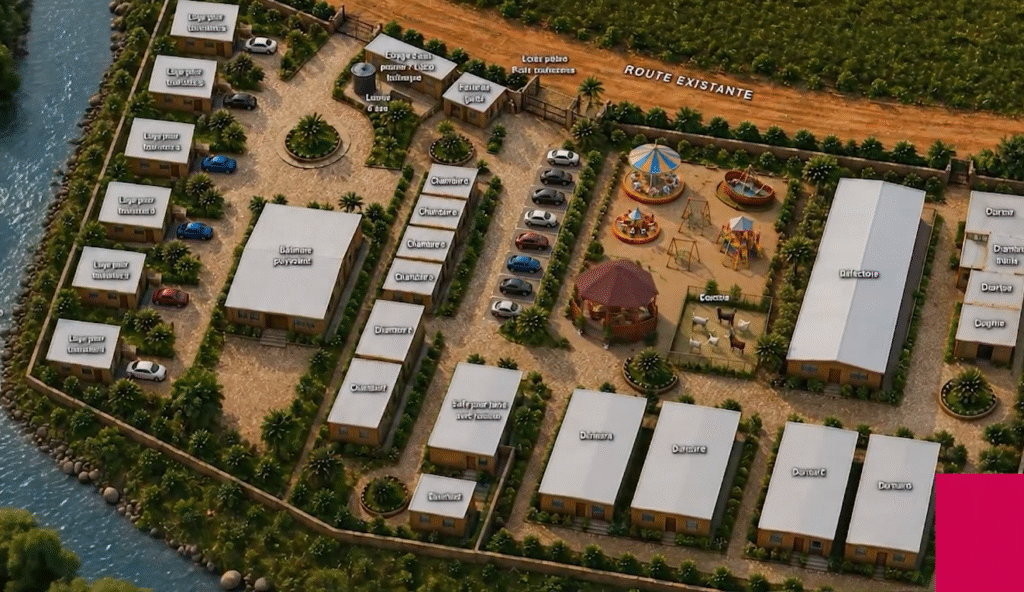
The first pilot centre is currently being developed. Further regional sites are under consideration.
The same principle, but different approaches depending on the region
Impact sur l’Avenir does not seek to replicate the same type of centre from one region to another. Each project is based on the specific circumstances of the local area: social needs, access to essential services, available resources, geographical constraints, local skills and economic opportunities.
The social centre and the income-generating infrastructure are therefore designed as a single integrated whole. The economic activities selected must be tailored to local circumstances and contribute progressively to the operation, consolidation and development of the social mission.
Our various programmes
Pilot Centre — Municipality of Essé, Centre Region, Cameroon
UNDER DEVELOPMENT
Location and regional context
Nkolavolo II – Ndoumzock is a rural village situated in the commune of Essé, in the Mefou-et-Afamba department, in the Central Region. The site selected for the pilot centre is located approximately 3 km from the tarmac road. The area is not connected to the electricity grid and mobile phone coverage remains poor, which means that self-sufficient solutions for energy, water and communications must be incorporated from the design stage.
When the project was launched, local educational provision was severely compromised. The neighbouring state school, which serves as the local educational facility for children in the area, had been closed for three years. This situation illustrates the difficulties in accessing sustainable social services in the village and the surrounding areas.
Why Nkolavolo II?
The choice of Nkolavolo II is based on several complementary factors: the needs expressed by the community, the village’s rural location, the availability of sufficient space to develop both social and productive infrastructure simultaneously, and the opportunity to create a project that benefits not only the Centre but also its immediate surroundings.
The Pilot Centre was therefore conceived not as an isolated entity, but as a hub capable of gradually strengthening education, economic activity and the services available in the village and its surroundings.
The social response
The ISA Pilot Centre’s mission is to take in, protect and support vulnerable children, particularly those who have been abandoned, are orphans or lack a sufficiently protective family environment. Its initial capacity is around 80 children, with a gradual increase in capacity.
The facility comprises the spaces required for daily life and support: accommodation, a kitchen, a dining hall, sanitary facilities, early learning and educational areas, as well as spaces for technological, artistic, cultural and sporting activities. The aim is to provide comprehensive care whilst ensuring close integration with the local community.
Education and community engagement
The Foundation has reoriented its educational project so as not to create a parallel infrastructure where a state school already exists nearby. Priority has therefore been given to the refurbishment and reopening of the neighbouring state school, which had been closed for three years, so that it can accommodate both the children from the Centre and those from the surrounding villages.
This approach enables social investment to be used as a tool that benefits the whole community and strengthens existing public infrastructure rather than bypassing it.
Revenue infrastructure
To gradually contribute to the Centre’s operations, a number of income-generating activities have been planned and will be rolled out in stages:
- Fish farming: the production of fish in dedicated ponds, with a gradual increase in the farm’s capacity.
- Shellfish farming: gradual expansion of this activity is planned at the site, alongside fish farming and other production activities.
- Pig farming: further development of a pig farm tailored to the site’s capacity and identified market opportunities.
- Poultry farming: the gradual introduction of poultry production to complement the Centre’s other activities.
These activities are not a substitute for the external funding required for construction and equipment. Their aim is to gradually build up the Centre’s own capacity to contribute towards its running costs.
Current phase
Gradual completion of the infrastructure, refurbishment of the state school, preparations for the Centre’s operational launch, and the roll-out of the first income-generating activities.
Regional Centre Project — Eastern Region, Cameroon
TERRITORIAL FRAMEWORK
Location and regional context
Garoua-Boulaï is a border town in the Eastern Region, situated on the Cameroon–Central African Republic route and on the Douala–Bangui corridor. Its location makes it a key transit point for people, goods and produce between Cameroon and the Central African Republic.
This economic momentum coexists with social vulnerabilities and a need to better connect local communities – particularly women and girls – to the opportunities created by agriculture, livestock farming, processing, trade and cross-border flows.
Why Garoua-Boulaï?
The area was selected as the focus for the ‘Les Bâtisseuses des Frontières’ programme due to its strategic location on a regional corridor, the scale of trade with the Central African Republic, and the potential to better link local production to established markets.
The aim is not to replicate the Nkolavolo II Centre there. On the contrary, ISA is seeking to develop a model specific to a border area, in which women’s economic empowerment and the development of local value chains form the core of the social response.
The proposed social response: Les Bâtisseuses des Frontières
The programme is primarily aimed at women and girls in border areas. It is designed to help foster the emergence of organised, technically competent women producers who receive support for their activities and are connected to more regular markets.
The future regional centre is envisaged as a hub for: training; the provision or organisation of inputs; technical support; quality control; collection; storage; consolidation; and marketing. Production, meanwhile, is intended to remain largely based in the villages and production areas.
Revenue infrastructure
The focus of the work is on agriculture and livestock farming, supplemented where relevant by processing, storage, preservation and marketing. However, the specific sectors have not yet been finalised at this stage: they are to be selected following regional consultations, taking into account available resources, local expertise, technical constraints and actual market opportunities.
The mechanism in question is simple: women producers are paid for their compliant produce; the Foundation organises the collection and marketing of the produce; a portion of the profit margins is then used to fund support services, logistics, inputs, monitoring, working capital and the gradual expansion of the programme.
Developing the project in partnership with the local community
The current phase is deliberately focused on listening. Local authorities, technical services, social organisations, women’s organisations, producers, livestock farmers, traders, transport operators, associations and other stakeholders must be consulted before finalising the centre’s remit.
The specific site, the infrastructure to be built and the priority sectors will therefore be defined once this scoping exercise has been completed. This transparency must remain clearly visible on the website: Garoua-Boulaï is currently a regional project in the planning stage, not a centre that has already been built.
Current phase
Establishing contact with local stakeholders, preparing for local consultation meetings and defining the economic and social framework. The consultation meetings are scheduled to take place between 1 and 30 September 2026.
Regional Centre Project — Far North Region, Cameroon
TERRITORIAL FRAMEWORK
Location and regional context
Kousséri is situated in the Logone-et-Chari department, in the Far North Region, on the border with Chad and immediately adjacent to N’Djamena. The town lies on the Douala/Kribi–N’Djamena corridor, one of the main routes for the movement of goods between Cameroon and Chad.
The Far North region also faces significant challenges in terms of resilience, access to essential services, employment and climate adaptation. In this context, local and cross-border economic activities can become a practical means of empowerment when they are better structured and linked to markets.
Why Kousséri?
The choice of Kousséri is linked to its location on the border, its close proximity to the N’Djamena market, the scale of cross-border trade, and the potential of a programme combining production, food security, storage, the organisation of women producers and access to markets.
As in Garoua-Boulaï, the project aims to harness the momentum of the corridor not as an end in itself, but as an opportunity to strengthen the economic capacity of the women and communities living around these trade routes.
The proposed social response: Les Bâtisseuses des Frontières
The Kousséri regional centre is intended to serve as a hub for training, support and economic development for women and girls. It will be able to provide technical training, financial education, entrepreneurial support, assistance with setting up groups or cooperatives, collection, quality control, storage and access to markets.
Production must remain based in the villages and production areas. The centre then acts as a platform for services and marketing, so that individual women producers do not have to bear the burden of supply, storage, quality control, transport and marketing on their own.
Revenue infrastructure
The final activities will be decided following an assessment and consultation. The areas under consideration include, in particular, agriculture, livestock farming, the storage and preservation of produce, as well as its processing and marketing where economic conditions warrant it.
The economic model remains that of the Bâtisseuses des Frontières: initial funding provides the tools and support; production generates income for the beneficiaries; marketing then gradually contributes to the organisation’s running costs, working capital and the development of the network.
Developing the project in partnership with the local community
ISA does not wish to set Kousséri’s priorities from a distance. The framework must involve administrative and municipal authorities, social and technical services, women’s organisations, farmers and livestock breeders, traders, transport operators, community organisations and other local stakeholders.
These consultations will help to identify the priority social need, the most viable sectors, the precise role of the future centre and the infrastructure that is genuinely required. Until this stage is complete, the website should present Kousséri as a project within a regional framework.
Current phase
Identifying stakeholders, establishing contact, preparing for consultations and defining the scope of the study for the future regional centre.
Centres that evolve alongside their local areas
Nkolavolo II, Garoua-Boulaï and Kousséri represent three different contexts. The first is a pilot centre already under development in a rural setting; the other two are regional centre projects still in the planning phase, designed to address the specific circumstances of border areas.
This difference in maturity must be clearly evident. The ‘Our Centres’ page should provide information without giving the impression that all sites are at the same stage.
The information provided on this page is updated in line with the actual progress of each project.